Free Download The Information: A History, a Theory, a Flood, by James Gleick
Discussing leisure activity, one of the pastimes that make a person successful is reading. Additionally, reviewing a high professional publication. One that you can pick as the resource is The Information: A History, A Theory, A Flood, By James Gleick This is not type of conventional book that has excellent name. It is specific publication that we actually recommend you to read. By having hobby to read books, you can constantly enhance your mind in all the moment. And just what you could take now in order to help you discover the responsible analysis material is this book.
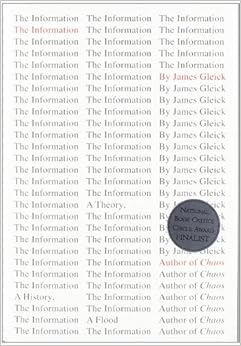
The Information: A History, a Theory, a Flood, by James Gleick

Free Download The Information: A History, a Theory, a Flood, by James Gleick
Thanks for visiting one of the most finished and also updated web site that bring numerous publication checklists. This is exactly what you could consider getting the book as the referral for you in doing the discussion to really feel better. Guide that comes to be referral to read now is The Information: A History, A Theory, A Flood, By James Gleick This is among guides that we list as one part of the wonderful numerous publications from around the world. So, when you discover as well as browse the book titles right here, it will certainly be from several nations in the world. So, it's so finished, isn't it?
As we claim, the book that we provide in the connect to download and install is the soft file types. So, it will let you go out to seek for book. As well as currently, to upgrade our collection, The Information: A History, A Theory, A Flood, By James Gleick as the most up to date book coming is given. This is among the best seller publications that originate from a professional author. Besides, the writer has enhance the package of the book to be much interesting. It doesn't should think increasingly more to obtain every meaning kind this book.
This publication is really conceived to supply not only the recent life yet additionally future. By offering the advantages of this The Information: A History, A Theory, A Flood, By James Gleick, possibly it will certainly lead you to not be doubt of it. Be among the excellent readers in the world that constantly review the top quality publication. With the certified books, you can sharpen your mind and also thought. This is not only about the opinion; it's everything about the truth.
Simply link your device computer system or gizmo to the web attaching. Obtain the contemporary technology to make your downloading and install The Information: A History, A Theory, A Flood, By James Gleick completed. Even you don't intend to read, you can straight shut guide soft file and open The Information: A History, A Theory, A Flood, By James Gleick it later on. You could additionally quickly get the book almost everywhere, since The Information: A History, A Theory, A Flood, By James Gleick it remains in your gizmo. Or when remaining in the workplace, this The Information: A History, A Theory, A Flood, By James Gleick is also recommended to check out in your computer tool.
Amazon.com Review
Amazon Best Books of the Month, March 2011: In a sense, The Information is a book about everything, from words themselves to talking drums, writing and lexicography, early attempts at an analytical engine, the telegraph and telephone, ENIAC, and the ubiquitous computers that followed. But that's just the "History." The "Theory" focuses on such 20th-century notables as Claude Shannon, Norbert Wiener, Alan Turing, and others who worked on coding, decoding, and re-coding both the meaning and the myriad messages transmitted via the media of their times. In the "Flood," Gleick explains genetics as biology's mechanism for informational exchange--Is a chicken just an egg's way of making another egg?--and discusses self-replicating memes (ideas as different as earworms and racism) as information's own evolving meta-life forms. Along the way, readers learn about music and quantum mechanics, why forgetting takes work, the meaning of an "interesting number," and why "[t]he bit is the ultimate unsplittable particle." What results is a visceral sense of information's contemporary precedence as a way of understanding the world, a physical/symbolic palimpsest of self-propelled exchange, the universe itself as the ultimate analytical engine. If Borges's "Library of Babel" is literature's iconic cautionary tale about the extreme of informational overload, Gleick sees the opposite, the world as an endlessly unfolding opportunity in which "creatures of the information" may just recognize themselves. --Jason Kirk
Read more
From Publishers Weekly
Starred Review. In 1948, Bell Laboratories announced the invention of the electronic semiconductor and its revolutionary ability to do anything a vacuum tube could do but more efficiently. While the revolution in communications was taking these steps, Bell Labs scientist Claude Shannon helped to write a monograph for them, A Mathematical Theory of Communication, in which he coined the word bit to name a fundamental unit of computer information. As bestselling author Gleick (Chaos) astutely argues, Shannon's neologism profoundly changed our view of the world; his brilliant work introduced us to the notion that a tiny piece of hardware could transmit messages that contained meaning and that a physical unit, a bit, could measure a quality as elusive as information. Shannon's story is only one of many in this sprawling history of information. With his brilliant ability to synthesize mounds of details and to tell rich stories, Gleick leads us on a journey from one form of communicating information to another, beginning with African tribes' use of drums and including along the way scientists like Samuel B. Morse, who invented the telegraph; Norbert Wiener, who developed cybernetics; and Ada Byron, the great Romantic poet's daughter, who collaborated with Charles Babbage in developing the first mechanical computer. Gleick's exceptional history of culture concludes that information is indeed the blood, the fuel, and the vital principle on which our world runs. (Apr.) (c) Copyright PWxyz, LLC. All rights reserved.
Read more
See all Editorial Reviews
Product details
Hardcover: 544 pages
Publisher: Pantheon; First Edition edition (March 1, 2011)
Language: English
ISBN-10: 0375423729
ISBN-13: 978-0375423727
Product Dimensions:
6.7 x 1.8 x 9.7 inches
Shipping Weight: 2.1 pounds (View shipping rates and policies)
Average Customer Review:
4.2 out of 5 stars
259 customer reviews
Amazon Best Sellers Rank:
#257,295 in Books (See Top 100 in Books)
As someone who has been in computers and information sciences since 1970, this was an amazing and entertaining book.I knew a lot of the history, having lived some of it, but a lot of this was new to me.Very well-researched and presented in a clear and highly readable style. This volume clearly covers the concepts and development of theories of information. It covers both theory and practice and whether you are a beginning computer programmer or an information science theorist, you should find something in here that you didn't know and that will awaken you to some new ideas.If you like this volume, try "Godel, Escher, Bach" by Douglas Hofstadter. That is an eclectic and entertaining mix of mathematics, art, and music philosophy, tying together apparently dissimilar disciplines into a mind-bending tour-de-force.
The is the first James Gleick work that I have read. I am impressed. He writes cleanly and clearly, with little "fluff" and he seems to understand what he is writing about. It surely took a lot of background work before he was ready to tie so many disparate pieces of history together. I am also impressed in that Mr Gleick seems clearly to want to get the history right and not to push his personal ideas, interpretations, morals, and politics. I am reminded of the James Burke (BBC/PBS) works as he shows how knowledge that at first seems unrelated becomes related thru the work of many men and women scattered in time and geography. This is a history, not a textbook on information theory; there is only a smattering of simple formulae and drawings.The book uses the contributions of Claude Shannon as a thread to tie everyone's work together, but this is not a biography of Claude Shannon.The final chapters are a bit weak in my opinion, especially following such solid work as the preceding chapters. One of the weak (in my opinion) chapters is devoted entirely to Wikipedia. I am enthused with Wikipedia but I don't think it is yet clear what will be a future historian's view of Wikipedia and that it deserves its own full chapter.Overall I found the book to be very enjoyable and educational, adding considerably to my previous knowledge of Mr Shannon's work and bringing me new knowledge of how Mr Shannon's work linked with the work of others to bring us our current "information age."
I wondered what aspect of information Gleick would be treating - knowledge and its communication and storage, the rise of information in physics as a conceptual inverse to entropy and its engagement in black hole theory, or even the information age.My complete satisfaction with Gleick's past work, especially the thoroughness of his notes and his eclectic exposition, compelled me to preorder this book. The Information is all of the above and more. He presents a history, including the fundamentals of language as, for example, employed for millennia by African drummers, then traverses the history of writing (even spelling), difference and analysis engines to the evolution of telegraphs and telephony. The theory then champions the work of Godel, Turing, Shannon, von Neumann and Wiener as information takes on a physical context and leaps into the age of digital logic. Gleick's notes became my list for texts to further read around the topic. Then comes the flood, the rise on the internet, Wiki and the cloud.The Information is a rewarding and enjoyable read and contains many of the charming minutiae that Gleick's research uncovers. As he listed the objectives of Russell and Whitehead's Principia Mathematica and its imminent demolition, Gleick describes the early days of the demolisher, Godel, attending smoky Viennese coffee houses and expounding logic. Highly recommended.
There are two milestones that shape the main theses in this book. The first is, naturally, Claude Shannon's formulation of his "Information Theory". Shannon is rightfully the main character of this historical saga (Gleick inserts biographical snippets of him and other main character throughout the book). The second pivotal moment comes with the intrusion of entropy in this theory and in the realization that information, as a physical entity, is also subjected to it.Gleick is a great writer and a pleasure to read. He presents his topic thematically, chronologically, and inserting biographical elements to shape something like an informational saga. He not only engages the reader but also explain difficult concepts in great detail (his presentation of Gödel's incompleteness theorems is an example.)With an intermixture of Entropy and Information Gleick discusses the most important issue from a human perspective: how to extract knowledge and wisdom from a flood of data. It is very interesting to realize that our modern discussion is just a last iteration of searching and filtering. From library indexing, book catalogs, almanacs through our modern Internet algorithms, the problem remains the same: when all information is available, how do you find it and when does it become meaningful? The author is right in using Borges's "The Library of Babel" as the perfect metaphor for it.
This book was hard to get through but only because there was so many incredibly important ideas. I read this months ago and I am still thinking about it. The part I disliked? That there was almost no actual communications research presented. All (or all but a tiny bit) came from engineering or computer science. University communications departments have ceded the entirety of modern communications theory and practice to others. And the worst part is that they don't even care or seem aware of that fact. So... my review of the book? Read it. It is fascinating and one of the most important books to read if you want to get a good, basic overview of the ideas that will shape the next 50 years or more. If you are affiliated with any university department of communications you should be ashamed for a bit and then start fixing the last 50 years of irrelevancy this book clearly has exposed.
The Information: A History, a Theory, a Flood, by James Gleick PDF
The Information: A History, a Theory, a Flood, by James Gleick EPub
The Information: A History, a Theory, a Flood, by James Gleick Doc
The Information: A History, a Theory, a Flood, by James Gleick iBooks
The Information: A History, a Theory, a Flood, by James Gleick rtf
The Information: A History, a Theory, a Flood, by James Gleick Mobipocket
The Information: A History, a Theory, a Flood, by James Gleick Kindle
The Information: A History, a Theory, a Flood, by James Gleick PDF
The Information: A History, a Theory, a Flood, by James Gleick PDF
The Information: A History, a Theory, a Flood, by James Gleick PDF
The Information: A History, a Theory, a Flood, by James Gleick PDF