
Download Bing Crosby: A Pocketful of Dreams--The Early Years 1903-1940, by Gary Giddins
Checking out books will not obligate you to complete it in a day. After your reading book now, Bing Crosby: A Pocketful Of Dreams--The Early Years 1903-1940, By Gary Giddins can be the selected book to be. We suggests as a result of the high quality of this publication. It showcases something brand-new as well as different. You may not need to assume considerably, yet simply review and you will certainly see why this publication is much advised.
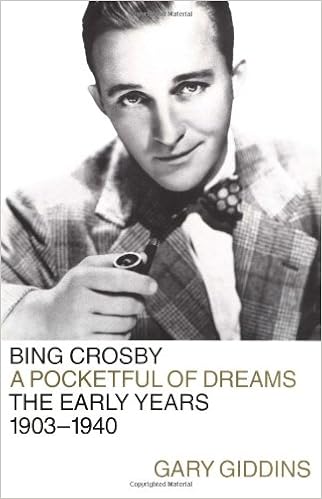
Bing Crosby: A Pocketful of Dreams--The Early Years 1903-1940, by Gary Giddins

Download Bing Crosby: A Pocketful of Dreams--The Early Years 1903-1940, by Gary Giddins
Do you think that reading is a crucial activity? Find your reasons including is very important. Checking out a book Bing Crosby: A Pocketful Of Dreams--The Early Years 1903-1940, By Gary Giddins is one component of satisfying tasks that will make your life top quality much better. It is not concerning simply exactly what type of publication Bing Crosby: A Pocketful Of Dreams--The Early Years 1903-1940, By Gary Giddins you check out, it is not simply concerning the number of books you read, it's regarding the routine. Reading behavior will be a method to make book Bing Crosby: A Pocketful Of Dreams--The Early Years 1903-1940, By Gary Giddins as her or his friend. It will despite if they invest cash and invest more e-books to finish reading, so does this book Bing Crosby: A Pocketful Of Dreams--The Early Years 1903-1940, By Gary Giddins
For everybody, if you intend to begin joining with others to review a book, this Bing Crosby: A Pocketful Of Dreams--The Early Years 1903-1940, By Gary Giddins is much recommended. And also you should get the book Bing Crosby: A Pocketful Of Dreams--The Early Years 1903-1940, By Gary Giddins right here, in the link download that we provide. Why should be here? If you desire various other kind of publications, you will certainly constantly locate them and Bing Crosby: A Pocketful Of Dreams--The Early Years 1903-1940, By Gary Giddins Economics, politics, social, sciences, religions, Fictions, and much more publications are supplied. These offered publications are in the soft data.
Someone will certainly constantly have factor when providing occasionally. As here, we likewise have a number of affordable benefits to take from this publication. Initially, you can be among the hundreds individuals who read this Bing Crosby: A Pocketful Of Dreams--The Early Years 1903-1940, By Gary Giddins, from numerous locations. After that, you can get a really simple means to discover, get, and read this book; it's presented in soft data based upon online system. So, you can read it in your gadget in which it will certainly be constantly be with you.
When someone could supply the presence of this publication, you could get this book as soon as possible. It will certainly not require many times, one more time. It will certainly provide you ease ways. This finest offered publication from the most effective writer actually comes to bone of needed and also wanted publication to motivate. Bing Crosby: A Pocketful Of Dreams--The Early Years 1903-1940, By Gary Giddins as the brand-new book can join this globe appropriately. As well as currently, follow us to get this impressive book.
From Publishers Weekly
Jazz critic Giddins's latest subject will probably surprise those who think of Bing Crosby (1903-1977) as "a square old man who made orange-juice commercials" and sang "White Christmas" every year on TV. Giddins reminds us that, in the 1920s and '30s, Crosby was a very jazzy singer indeed: "the first white performer to appreciate and assimilate the genius of Louis Armstrong." This sober, comprehensive biography lacks the thematic breadth and action-packed sentences that made Giddins's Visions of Jazz so memorable, but it's a perceptive portrait of Crosby as a man, a singer, a radio personality and a budding movie star in the loose, creative years before he hardened into a monument. Giddins's account of Crosby's middle-class, Irish-American youth in Washington State astutely stresses this singer's years of Jesuit schooling, which made him unusually well educated for a performer and grounded him in values that contributed to the modesty, reserve and self-confidence American audiences found so appealing. Tracing Crosby's rise through vaudeville, Paul Whiteman's band, short films and radio shows, Giddins also offers a mini-history of technology's impact on popular music, most notably Crosby's famous ability to use a microphone to create a more intimate singing style. There's a bit too much background on minor characters and on forgettable films before readers arrive at The Road to Singapore, which launched Crosby's epochal partnership with Bob Hope. But Giddins amply makes his case that Crosby "came along when American entertainment was at a crossroads [and] showed it which road to take." Photos not seen by PW. (Jan.) Forecast: Giddins has long been popular among serious jazz fans, and his name recognition jumped after Visions of Jazz won a National Book Critics Circle Award in 1998. The first volume of a multipart biography, this book will be further boosted by advertising and an eight-city author tour, including an appearance on Ken Burns's PBS documentary, Jazz, airing in January. Copyright 2000 Reed Business Information, Inc.
Read more
From Booklist
Those who remember Bing Crosby only for "White Christmas" may be surprised to find jazz-critic Giddins, the author of books on Louis Armstrong and Charlie Parker, singing Der Bingle's praises as "one of the handful of artists who remade American music in the 1920s." Through a combination of careful research and precise, remarkably insightful analysis of vocal technique, Giddins shows how Crosby, the first white singer to recognize the genius of Louis Armstrong, remade our notion of pop singer (the term didn't even exist before Crosby), developing a vocal style that was based on intimacy and naturalness--the very opposite of the artificial, effeminate tenors who were fronting orchestras before Bing. Following Crosby's development from childhood in Spokane, Washington, through a revolutionary period with Paul Whiteman's band (where Bing quickly associated himself with other top jazzmen including Bix Beiderbecke, Frank Trumbauer, and Joe Venuti), and on to his phenomenal solo career, on record, on radio, and in the movies, Giddins reveals how Crosby transformed mass entertainment, whether it was teaching a generation of American singers how to use a microphone or redefining what it means for an actor to "play himself." Above all, though, there was the Crosby persona: "Bing was quintessentially American, cool and upbeat, never pompous, belligerent, or saccharine, never smug or superior. He looked down on no one and up to no one." Or, as Artie Shaw put it: "Bing Crosby was the first hip white person born in the United States." In the course of reestablishing Bing as a hipster, Giddins has contributed a landmark study of popular singing in the first half of the twentieth century. But, like Bing, he does it without pomposity, and he swings. Bill OttCopyright © American Library Association. All rights reserved
Read more
See all Editorial Reviews
Product details
Hardcover: 736 pages
Publisher: Little, Brown and Company; First Edition edition (January 25, 2001)
Language: English
ISBN-10: 0316881880
ISBN-13: 978-0316881883
Product Dimensions:
6.5 x 1.6 x 9.5 inches
Shipping Weight: 1.6 pounds
Average Customer Review:
4.1 out of 5 stars
64 customer reviews
Amazon Best Sellers Rank:
#851,582 in Books (See Top 100 in Books)
I have increasing trouble reading non-fiction on electronic devices! I’m forever going off to Google to look items and people up then that leads to more look-ups, etc. This biography of Bing is much worse! Now I do not only the usual tangents, but my wife and Alexa and I have to listen to all of the many old songs in Bing’s repertoire. And Amazon Music has nearly all of them! It seems like I’ve been at this book all summer. It is a fantastic biography of Bing by an excellent author and so well footnoted!
I came to this book after reading Jerry Lewis 'Dean and Me", Nick Tosches (novel like) 'Dino' and Frank Sinatra 'The Voice' by James Kaplan so I was in the mood to read more about singers and entertainers of mid century era. This book is the best of the bunch. It has renewed my enjoyment of Bing and put into context his success and the success of later performers like Dean and Frank. Interest in him has lapsed possibly due to his scattered and often low fidelity recorded legacy and negative stories about his harsh rearing of children in his first marriage. He was by far the most popular figure in show biz in the mid 30's to mid 50's. The biggest movie box office attraction, the biggest radio attraction and easily the highest selling recording artist. In the day he was the personification of cool. I read this while watching some of the old movies, listening to his music and most of all listening to his radio shows (My Old Radio.com) where his easygoing banter with guests and regulars shows the core of his appeal.The book is really well written and is entertaining without pretending to know what was going on in Bing's mind a flaw in Kaplan's book and especially Tosche's mentioned above. You get to know the people and events of long ago that created this incredible artist. Only problem it stops at Road to Singapore in 1940 and I REALLY want to read the rest of the story particularly the war years and High Society so Mr Giddins get on with it (PLEASE)!
Two giants of American Popular Music died in the fall of 1977. The death of Elvis Presley in August shocked the world. The young rebel who was the first white performer to bring Rhythm and Blues music and the sexuality that accompanied that music to a large white audience was merely 42 when he collapsed on the bathroom floor of his Memphis mansion. In the years since his death, Elvis has remained an iconic figure. The King of Rock and Roll continues to be big business, generating billions of dollars annually. Children recognize his image and know at least some of his music. Elvis' brief period of fiery creation in the mid fifties still looms large in the landscape of American culture.A month after Elvis' death, Bing Crosby died while on a golf course in Spain. The news of his death was not nearly as shocking as Elvis', given that Bing was in his seventies. Bing's long career was at an end by the time of his death. His appearances limited mostly to orange juice commercials and his annual Christmas specials on television. Largely forgotten in 1977 was the fact that Bing had also had a period of fiery artistic creation. Bing Crosby was the first superstar of American Popular Music, the first to assimilate the rhythms and delivery of African-American jazz into white popular music. In the years since his death, Bing Crosby has become a footnote, a trivia question. Two very unflattering biographies, one, a memoir of the Mommy Dearest variety, written by Bing's son Gary, have done little for Bing Crosby's reputation. But Bing Crosby was a giant. His influence as a singer was equally as important as Elvis Presley's. Jazz critic Gary Giddins, who contributed a great deal of commentary and insight to the Ken Burns film "Jazz", has attempted to resurrect the reputation of Bing Crosby in the first volume of a his detailed biography of Crosby, Bing Crosby, A Pocketful of Dreams, The Early Years 1903-1940. "Of the handful of artists who remade American music..." writes Giddins, "(Crosby) played a decisive role in transforming popular song from a maudlin farrago steeped in minstrelsy and vaudeville into a swinging, racially nuanced, and internationally accepted phenomenon that in one form or another dominated the age." Giddins argues, in the words of jazz artist Artie Shaw "Bing was the first hip white person born in The United States." Bing Crosby was not just a singer. He was a personality. He appeared in scores of films including his Oscar winning role in 1944's Going My Way, as well as his popular series of "Road" movies with Bob Hope. At its peak in the mid forties, Bing's radio program held 50 million listeners at a time when the population of America was about half what it is today. Pocketful of Dreams does a masterful job of detailing the rise of Crosby from his boyhood in Spokane to his peak as a star and an artist. Giddin's book does not ignore the charges leveled at Bing in the previous Biographies. Bing's personal life is discussed in detail, his drinking, his relationship to his children and so forth. Giddins simply gives a fuller picture of the man and his times and has no interest in the sensational details emphasized in those other books. "Neither saint nor monster," Giddins writes, "Crosby survives his debunkers along with his hagiographers because the facts are so much more impressive than the prejudices and myths on either side." Giddins unveils Crosby's secrets as a performer by analyzing key recordings in detail. He describes Bing's style as "disarmingly, almost nakedly, artless, yet so artful that he never shows his hand, never shows off his phrasing or his easy way of rushing or retarding a phrase, never does any of the things singers do to show you how hard they are working." This is the essence of what made Crosby an artist as well as a star. His appeal was great with both women and men. Women found him alluring in a romantic sense. The microphone was Bing's instrument, enabling him to sing in a natural voice, as if singing in your ear, never belting or crooning. His early hits were all sung personally. May I, Please, I Apologize, I Surrender Dear are all sung directly to the listener. The Beatles later used this device in their earliest hits: I Want To Hold Your Hand, From Me To You, All My Loving, and a song John Lennon acknowledges as being inspired by Crosby, Please Please Me, The Beatles first number one record on the charts. Men felt that Crosby was the sort of singer they would be if they were a singer. His casual approach allowed his male listeners to identify with Crosby in a way they never had with Al Jolson or the mannered Russ Columbo. Gary Giddins attempts to resurrect the original image of this 20th century giant and place him properly at the top of the list of purveyors of American popular song. The first volume ends with Crosby at the peak of his powers, the most heard voice in the world. His most popular films and recording still lay ahead. A second volume is promised, and will be most welcome.
Bing Crosby: A Pocketful of Dreams--The Early Years 1903-1940, by Gary Giddins PDF
Bing Crosby: A Pocketful of Dreams--The Early Years 1903-1940, by Gary Giddins EPub
Bing Crosby: A Pocketful of Dreams--The Early Years 1903-1940, by Gary Giddins Doc
Bing Crosby: A Pocketful of Dreams--The Early Years 1903-1940, by Gary Giddins iBooks
Bing Crosby: A Pocketful of Dreams--The Early Years 1903-1940, by Gary Giddins rtf
Bing Crosby: A Pocketful of Dreams--The Early Years 1903-1940, by Gary Giddins Mobipocket
Bing Crosby: A Pocketful of Dreams--The Early Years 1903-1940, by Gary Giddins Kindle