
Ebook Download Against Obligation: The Multiple Sources of Authority in a Liberal Democracy
To verify how this book will affect you to be much better, you can start checking out now. You might also have actually understood the writer of this publication. This is a very incredible publication that was written by expert writer. So, you might not really feel doubt of Against Obligation: The Multiple Sources Of Authority In A Liberal Democracy From the title as well as the writer additionaled the cover, you will be sure to read it. Even this is a basic book, the content is very important. It will certainly not should make you feel woozy after checking out.
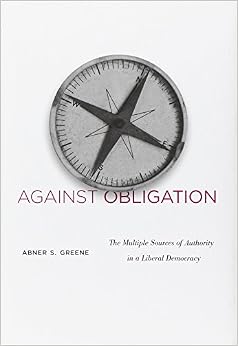
Against Obligation: The Multiple Sources of Authority in a Liberal Democracy

Ebook Download Against Obligation: The Multiple Sources of Authority in a Liberal Democracy
Having leisure time? Now is your time to begin your old hobby, reading. Checking out needs to be a routine and also leisure activity, not only as the responsibility. The book that you could read consistently is Against Obligation: The Multiple Sources Of Authority In A Liberal Democracy This is what makes many individuals really feel pleased for finding out more as well as much more. When you feel that reading is a behavior, you will certainly not feel careless to do it. You will certainly not really feel additionally that it will be so boring.
It can be among your morning readings Against Obligation: The Multiple Sources Of Authority In A Liberal Democracy This is a soft data book that can be survived downloading and install from on the internet publication. As known, in this sophisticated era, modern technology will certainly ease you in doing some tasks. Even it is just reading the presence of publication soft file of Against Obligation: The Multiple Sources Of Authority In A Liberal Democracy can be added attribute to open up. It is not only to open and also save in the gizmo. This time around in the morning and other free time are to read guide Against Obligation: The Multiple Sources Of Authority In A Liberal Democracy
Based upon that situation, it's clear that your time to read this publication will not spend squandered. You could start to conquer this soft data publication to prefer much better analysis product. Yeah, finding this publication as checking out publication will provide you unique experience. The intriguing subject, very easy words to recognize, and also attractive enhancement make you really feel comfy to only read this Against Obligation: The Multiple Sources Of Authority In A Liberal Democracy
This is likewise one of the factors by obtaining the soft documents of this Against Obligation: The Multiple Sources Of Authority In A Liberal Democracy by online. You could not need more times to invest to go to the book store and search for them. In some cases, you additionally don't find guide Against Obligation: The Multiple Sources Of Authority In A Liberal Democracy that you are hunting for. It will certainly lose the moment. But here, when you visit this page, it will be so very easy to obtain and also download and install guide Against Obligation: The Multiple Sources Of Authority In A Liberal Democracy It will certainly not take lots of times as we state in the past. You could do it while doing another thing in your home or also in your office. So very easy! So, are you question? Merely practice just what we provide below and review Against Obligation: The Multiple Sources Of Authority In A Liberal Democracy just what you like to review!
Review
In Against Obligation, Abner Greene upends conventional wisdom about several fundamental political questions. Why and when must people obey the law? What does religious freedom require in a liberal democratic state? Must judges and citizens respect historical views about constitutional meaning? Smart, ambitious, provocative, and original―this tightly argued and broad-ranging book compels readers to reexamine basic assumptions about political obligation, constitutional democracy, and religious freedom. (Christopher Eisgruber, Princeton University)Against Obligation is one of the finest contributions to constitutional theory in recent years. Abner Greene shows the connections between questions of political and interpretive obligation in this remarkably incisive work. His arguments against the leading justifications of political and interpretive obligation are vigorous and fair. And his arguments for the multiple sources of obligation and interpretive authority in a liberal democracy are creative, normatively attractive, and deeply grounded in a powerful account of our constitutional order. (James E. Fleming, Boston University)
Read more
About the Author
Abner S. Greene is Leonard F. Manning Professor of Law at Fordham University.
Read more
Product details
Hardcover: 352 pages
Publisher: Harvard University Press (April 25, 2012)
Language: English
ISBN-10: 0674064410
ISBN-13: 978-0674064416
Product Dimensions:
6.8 x 1 x 9.5 inches
Shipping Weight: 1.4 pounds (View shipping rates and policies)
Average Customer Review:
4.0 out of 5 stars
1 customer review
Amazon Best Sellers Rank:
#2,053,223 in Books (See Top 100 in Books)
Despite its title, this book isn't some sort of anarchist tract. Abner Greene (AG) is arguing against some very specific obligations, namely (i) an obligation always to obey the law, regardless of its content, (ii) an obligation always to respect the past in the juristic sense, including respecting the "original meaning" of the Constitution and respecting judicial precedent, and (iii) an obligation always to respect the US Supreme Court's interpretations of the Constitution. (Philosophers give the name "political obligation" to obligations like (i), and AG gives the name "interpretive obligation" to (ii) and (iii).) Even if we take these only as prima facie obligations, i.e. being subject to override in particular circumstances, AG argues that they don't exist. I've recently posted a lengthy review of this book on a law blog called Concurring Opinions, so here I'll just mention a few main points.I thought the most successful part of the book was Chapter 4, dealing with (iii). AG lays out the circumstances in which public officials -- including the President, Congress, lower court Federal judges, and even state and local officials -- ought to feel comfortable about acting on their own interpretations of the Constitution, even if the Supreme Court has said that it means something else. Many of its arguments were new to me. Chapter 3, about why even the Supreme Court shouldn't get hung up on originalism or even on following its own precedent (issue (ii)) was also quite good for an American audience, though I don't expect a majority of the Justices will follow AG's advice anytime soon. Note that AG doesn't argue that precedent should always be ignored: rather, he argues that it should be merely one influence among others on a judicial opinion. Similarly, in the context of (iii), the Supreme Court's interpretations might raise good points that public officials should consider; the point is that they don't have a duty always to follow those interpretations just because they emanated from the Court.Political obligation has been controversial for a long time, and while AG isn't the first to deny its existence, his Chapter 1 provides a very densely-argued rebuttal to the best-known theories by British and American writers. This chapter is written at a relatively high level of abstraction, and (along with the Introduction) may be tough going for some readers. Chapter 2 provides a sort of affirmative argument for why the State should recognize that its jurisdiction is "permeable -- full of holes." On this basis, the State should sometimes grant exemptions to, e.g., religious groups so that they can live "by themselves," as long as they "abide by constitutional rules." I thought this chapter was quite problematic, for reasons discussed in depth in the Concurring Opinions review.Just as the title might mislead you about the scope of book's arguments, so might the subtitle: "The Multiple Sources of Authority in a Liberal Democracy". The book's arguments are really focused on the US case only, not on liberal democracies generally, or else will be most persuasive to scholars who share certain American philosophical tastes. For example, the UK is a liberal democracy, but lacks judicial review of Parliamentary legislation, so all or most of Chapter 4 wouldn't apply. France and Germany are liberal democracies, but don't regard judicial precedent as binding in the way we do in the US. A reader familiar with a civil law system like those countries' will wonder what's the big deal about most of Chapter 3. AG's discussion in Chapter 1 assumes away much of the problematic of political obligation by explicitly assuming that law and morality are distinct; some Continental thinkers devote much more analysis to this problem, even if they share AG's skepticism about political obligation. And Chapter 2 is based almost entirely on the religion clauses of the First Amendment -- though ironically, German constitutional jurisprudence sometimes reaches similar results to those urged by AG, and might have made his argument more persuasive. Unfortunately, AG doesn't refer to any Continental sources since the 18th Century, and doesn't refer to any non-US court cases at all. To be fair: AG does at times make it clear that he's speaking only about the US case, especially in later chapters; and as for those portions of his argument where he speaks in a confusingly general or universal tone, he's in plentiful company. Many Anglophone legal philosophers, including Ronald Dworkin, are very unclear about the geographical scope of their comments, which often apply to the US (or at most, common law jurisdictions) alone.AG's style is dense and serious, but free from the critical studies jargon and vagueness currently fashionable in some parts of the legal academy. I was cheered to see that the book has both endnotes and a full bibliography. A book to contend with if you're interested in the philosophy of American constitutionalism, but perhaps less useful if your interests are more in comparative law or politics, or in political or legal philosophy more broadly.
Against Obligation: The Multiple Sources of Authority in a Liberal Democracy PDF
Against Obligation: The Multiple Sources of Authority in a Liberal Democracy EPub
Against Obligation: The Multiple Sources of Authority in a Liberal Democracy Doc
Against Obligation: The Multiple Sources of Authority in a Liberal Democracy iBooks
Against Obligation: The Multiple Sources of Authority in a Liberal Democracy rtf
Against Obligation: The Multiple Sources of Authority in a Liberal Democracy Mobipocket
Against Obligation: The Multiple Sources of Authority in a Liberal Democracy Kindle