
Free Download Bloodstoppers and Bearwalkers: Folk Traditions of Michigan’s Upper Peninsula
Reserve, an one of the secrets to go into the brand-new world constantly is cooperated a good way. Also you actually admire of this publication, you may not get anything from here. One way is just by taking the soft documents of Bloodstoppers And Bearwalkers: Folk Traditions Of Michigan’s Upper Peninsula to review as well as check out the book to complete. Recognizing just what the author utter can assist you to know and obtain the benefits of this book. So, it doesn't need the magic means to get motivations. It doesn't should take even more times as well as much loan to obtain this publication as your collection.
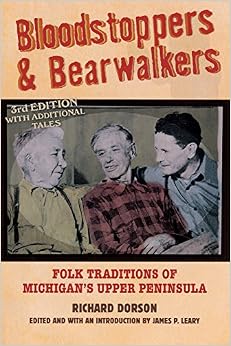
Bloodstoppers and Bearwalkers: Folk Traditions of Michigan’s Upper Peninsula

Free Download Bloodstoppers and Bearwalkers: Folk Traditions of Michigan’s Upper Peninsula
Thousands of ready-books to read are offered in this web site. We, as online collection site will certainly always give more recent or late upgrade of books from several nations in the world. It will lead you to relieve our means to seek for the alternative kinds of publications. Without travelling, without spending much loan, and also without investing much time end up being some benefits of taking books from this internet site. And below, a Bloodstoppers And Bearwalkers: Folk Traditions Of Michigan’s Upper Peninsula is just one of the most recent publication is welcome.
As understood, experience and encounter concerning driving lesson, amusement, and also understanding can be gotten by only reviewing a book Bloodstoppers And Bearwalkers: Folk Traditions Of Michigan’s Upper Peninsula Also it is not straight done, you can know more concerning this life, regarding the world. We offer you this appropriate as well as simple means to obtain those all. We provide Bloodstoppers And Bearwalkers: Folk Traditions Of Michigan’s Upper Peninsula and many book collections from fictions to scientific research in any way. One of them is this Bloodstoppers And Bearwalkers: Folk Traditions Of Michigan’s Upper Peninsula that can be your companion.
Well, in order to provide the very best book suggested, we lead you to obtain the link. This website constantly shows the link that is conformed to the book that is proffered. And also this time, Bloodstoppers And Bearwalkers: Folk Traditions Of Michigan’s Upper Peninsula in soft documents system is coming. This coming publication is also supplied in soft data. So, you can set it securely in the tools. If you frequently locate the published publication to check out, now you can discover the book in soft data.
From some problems that are presented from the books, we always end up being interested of just how you will get this publication. However, if you really feel that challenging, you could take it by adhering to the link that is offered in this site. Locate also the other listings of the books that can be had and checked out. It will certainly not limit you to just have this book. But, when Bloodstoppers And Bearwalkers: Folk Traditions Of Michigan’s Upper Peninsula becomes the first choice, just make it as real, as just what you actually intend to seek for as well as get in.
Review
“An important re-introduction of an American folklore classic.”—Carl Lindahl, University of Houston “A collection of traditions, tales, superstitions, practices, and folk biographies that range from the slyly humorous to the bawdy. . . . These are human beings, a folk, not sitting for a portrait, but caught alive as it were in fine amber, a permanent possession.”—Thelma G. James, Journal of American Folklore “Dorson’s first great book—published amidst Cold War clamoring for Americanism defined in narrow, Eastern-oriented, Anglo-Protestant, assimilationist terms—asserted unequivocally that the Upper Midwest, with its unruly democratic mixture of indigenous and immigrant peoples, its rustic working class babel of Native and foreign tongues, was also an American place, and a quintessential one at that. In writing what he did when he did, Dorson anticipated a whole generation of scholars dedicated to challenging canons by emphasizing the power, worth, and endless creativity of grassroots, plural, hybrid, and creolized cultures fermenting at the margins of staid, hierarchical social orders.”—James P. Leary, from the introduction
Read more
About the Author
Richard M. Dorson (1916–81) was a professor of history and folklore at Indiana University and the author of many books on American folk traditions, including American Folklore; America in Legend: Folklore from the Colonial Period to the Present; and Folklore and Folklif: an Introduction. James P. Leary is professor of folklore and Scandinavian studies at the University of Wisconsin–Madison, where he also directs the Folklore Program and is cofounder of the Center for the Study of Upper Midwestern Cultures. A native of northern Wisconsin, he is the author of Wisconsin Folklore; So Ole Says to Lena: Folk Humor of the Upper Midwest; and Polkabilly: How the Goose Island Ramblers Redefined American Folk Music.
Read more
See all Editorial Reviews
Product details
Paperback: 408 pages
Publisher: University of Wisconsin Press; 3 edition (May 30, 2008)
Language: English
ISBN-10: 9780299227142
ISBN-13: 978-0299227142
ASIN: 0299227146
Product Dimensions:
5.5 x 1.1 x 8.2 inches
Shipping Weight: 1 pounds (View shipping rates and policies)
Average Customer Review:
4.5 out of 5 stars
9 customer reviews
Amazon Best Sellers Rank:
#1,318,864 in Books (See Top 100 in Books)
The Upper Peninsula of Michigan is commonly called the U.P., thus its residents are Yoopers. The arrival of civilization in the U.P. created a number of resource extraction colonies to disassemble the wilderness paradise. Whites were attracted to the region to mine the furs, fish, copper, iron, and forests. Long winters and marginal soils have spared it from being obliterated by industrial agriculture and suburban sprawl. Population density is low. The biggest city, Marquette, has just 21,000 souls.Richard Dorson (1916-1981) was born into an affluent family in New York City. He received his PhD from Harvard. When he was hired by Michigan State University in 1944, he had never heard of the U.P. In 1946, the boarded the ferry at Mackinaw City, landed in the U.P., and spent five months researching the folklore of the region. He visited mining communities, lumber camps, beer gardens, and Indian villages, seeking out the venerable storytellers. They included the Anishinabe, Cornish, Finns, Irish, French, Slovenians, Croatians, Swedes, and many others. He met quite a few fascinating characters, listened to a lot of tall tales, and obviously had a good time in the process.Then he wrote Bloodstoppers & Bearwalkers, which presented a scruffy parade of rustic Yoopers. Harvard published it in 1952, after MSU refused to. Dorson's book is valuable because it recorded the essence of a number of cultures, many of which no longer exist. Typical Yoopers were the opposite of wealthy East Coast dandies. The whites often came from the lower classes of Europe, forced out of their homelands by the turbulence of the Industrial Revolution. Many had little or no education; more than a few were illiterate. They were strong, hard-working people who did not bloat and rot from soft indoor living.Most of Dorson's sources were born in the nineteenth century, but the oral cultures they came from had deep roots in the past, and deep roots in the living Earth. There were Yoopers who could shapeshift into bears, wolves, pigs, and owls. Potent curses could cause the death of others. Anishinabe and Finnish shamans had powers for counteracting black magic. Fairies were everywhere. Yoopers spent their lives in a land that was spiritually alive, rich with power and vitality.Dorson was hanging out with folks who were semi-Medieval at a time when modern America was dropping nuclear bombs, buying televisions, building skyscrapers, and zooming around in ridiculous automobiles. Sadly, the ancient art of storytelling, humankind's oldest profession, was being brushed aside by modern mass entertainment -- pulp magazines, soap operas, and movie thrillers.In the nineteenth century, Yooper communities spent long winters in isolation. The waterways froze, the roads were buried under deep drifts of snow, and stores had no fresh produce for months. In springtime, when the ice melted, the arrival of the first ship was always a day of joyful celebration and clattering church bells -- reconnection with the outer world. There was no television, radio, internet, phones, or recorded music. Entertainment on long winter nights came from telling old stories and singing old songs -- experiences shared by gatherings of family and neighbors, not in isolation with techno-gadgets.Many communities had bloodstoppers, who could stop heavy bleeding by speaking words of power, or a simple touch. There were far-sighted seers who could foretell the future, and psychics who could communicate with the spirits of the dead, or accurately describe things that were only known by you.In those days, life was filled with mysteries -- accidents, illness, deaths, disasters. Misfortunes were often explained as being the result of malevolent acts of evil people. The Anishinabe referred to these dark beings as bearwalkers, who could appear as animals, birds, or lights glowing in the night. The French called them loup-garous, something like werewolves, devious shapeshifters.As we move into the post-antibiotic era, the post-carbon era, the era of spectacular climate juju, life will be filled with mysteries and misfortunes once again. Without the ultra-expensive safety net of high-tech medicine, folks who are unwell will either recover or die, as the fates desire. There will be few stores, if any. We'll be far less mobile. Communication will be limited to those around us. We'll actually have to go outdoors -- yikes!The whites ravaged the U.P. because they knew almost nothing about ecological history, the mistakes of their ancestors. They did not have great powers of foresight, nor deep reverence for the health of the ecosystem. They remained addicted to an incoming flow of goods from distant industrial centers. Few of them unplugged themselves from civilization and learned to live with the land.The Anishinabe preserved a long tradition of reverence and respect for the family of life. Dorson noted that they "all live in the woods as if the cities of white men never existed." Of course, anyone who has ever experienced a city will understand why. They inhabited the same region as the whites, but the land was their home, a sacred place, where they were reverend guests -- an entirely different relationship.Today, we have fabulous education systems, and instant access to staggering quantities of information. Today, there are specialists who actually understand ecological history, and are extremely distressed by the mindless destruction caused by consumer society. But our schools do not major in teaching reading, writing, and ecological history. Our religious leaders do not teach us reverence and respect for creation. Tomorrow doesn't matter.Oddly, most of the graduates rolling off the academic assembly line these days are barely distressed at all. They are lost in a fantasy world, mesmerized by a moronic belief in perpetual economic growth, eager to devote their lives to accumulating and discarding unnecessary stuff. Sadly, the more our society is educated, the faster we destroy the future. Circle what is wrong with this picture.In 1900, many whites dreamed that their children would spend their lives mining and cutting pines. But in the decades that followed, as "infinite" resources became scarce, their communities and culture would be scattered to the winds. Many moved to Detroit, where there were no wolves, bears, or fairies, and their children were raised in the urban consumer culture, which displaced the old rustic one. Importantly, in just one generation, the culture of the youngsters was very different from the culture of their elders. Cultures can make sudden sharp turns, for better or worse.Another huge cultural shift is certain to occur as the collapse of industrial civilization proceeds. At some point, all the daffy infantile balderdash of the consumer worldview will have no purpose whatsoever. The throbbing lust for McMansions, giant pickups, and huge TVs will become meaningless. The game of life will be nothing like today.What can we do today to prepare the young for the coming storms? It would be awesome if we could help them acquire the intelligence needed to replace the loony consumer culture with a new one that is far more in balance with the family of life, something similar to the Anishinabe perhaps. We need to help them as much as we can before the lights go out.
Got this groundbreaking work in a timely fashion and immediately set about reading it. This 3rd edition is prefaced with the editor's cautionary notes about the author and his methodology. Great treatment!
We got this for our grandpa who is from Republic. He LOVED reading the stories and shared them with our little ones.
Being a Yooper, I'm fascinated with all of the folklore associated with the people and places of my homeland, especially related to Finns. Although some stories could have used more explanation and details, this is a really fun read.
This book was a disappointment. Not at all what I was expecting. The stories were for the most part, not very entertaining. It was a difficult read to plow my way through this one.
I dislike admitting it, but I have rarely, if ever, found a university press book to be sheer, unadulterated fun. Yes, I've found many that were very good reading, eye-opening, and engrossing but until this book, I've never cracked a university press book that is just such a delight to read. Bloodstoppers and Bearwalkers is all of that and much more. When it was first published in 1952 it was hailed as "extraordinarily interesting, rich and bizarre," and was recognized as an instant classic of American folklore. What initially grabbed me by the collar, had me turning pages, and randomly dipping into the book was its fantastic collection of UP folklore, stories, and jokes.In 1946, the author received a fellowship from the Library of Congress for the study of American civilization. In April of that year, Dorson set off for five months to study American civilization in of all places -- Michigan's Upper Peninsula. He came to the UP to listen, collect, and record tall tales, superstitions, local stories, jokes, and customs that were brought to the rugged peninsula by Native Americans, loggers, and a veritable melting pot of immigrants. Here in the iron, fish, and timber rich peninsula the ethnic stories, folklore, and customs were warped, moulded, and mutated by the UP experience until a new culture and folklore emerged. Dorson called the Upper Peninsula, "one of the richest storytelling regions in the United States."The strange bouillabaisse of Finns, French Canadians, Ojibwas, Cornish, Poles, Italians, and Slovenians mixing their local customs, love of stories, bawdy wit, and extravagant tales are here enshrined in 300-plus pages. This 3rd edition of Dorson's original work is graced by a new introduction and the addition of newly collected gems. I didn't read the book cover to cover because I had more fun dipping into it here and there as if panning for gold. I found it in abundance, from cunningly mischievous characters, and weird tales of shape changers, to ghost ships, sly and cunning tricksters, and a huge helping of simply laugh-out-loud jokes and stories.Here's a sampling, bits and pieces in a few cases, of some of my favorites. When a lumber camp ran low on food a committee was selected to make for the nearest town to buy supplies. When the committee returned the resupply consisted of "several cases of whiskey and a couple of loaves of bread. After staring silently at this exhibit, one jack dourly remarked, "What are we gonna do with all the bread?""A Swede goes back to the Old Country and is asked how he liked America. "Py Yesus, it take me twenty year to learn to say yelly and den dey call it yam."And my favorite is told in a Finnish dialect. A Finnish tavern owner by the name of Frank Uotila from Mass, Michigan visited Hancock. On his return home he had a small sign reading "Nineteen-F-U-twenty-eight" placed on his tavern. When asked why he put those letters and numbers on his building he replied, "Well, I peing up py dat Hancock blace, I seen pilding up dere, it saying nineteen-oh-von-A-D. I asking someone what dat meaning and dey tellin me dat meaning Anno Domini. I saying tis: If dat dem Dago, he putting his 'nitials on his pilding, I put my 'nitials on my pilding."A truly unique book about a unique corner of our world.
Bloodstoppers and Bearwalkers: Folk Traditions of Michigan’s Upper Peninsula PDF
Bloodstoppers and Bearwalkers: Folk Traditions of Michigan’s Upper Peninsula EPub
Bloodstoppers and Bearwalkers: Folk Traditions of Michigan’s Upper Peninsula Doc
Bloodstoppers and Bearwalkers: Folk Traditions of Michigan’s Upper Peninsula iBooks
Bloodstoppers and Bearwalkers: Folk Traditions of Michigan’s Upper Peninsula rtf
Bloodstoppers and Bearwalkers: Folk Traditions of Michigan’s Upper Peninsula Mobipocket
Bloodstoppers and Bearwalkers: Folk Traditions of Michigan’s Upper Peninsula Kindle